Monday, April 13, 2015

Introduction - Mondulkiri, Cambodia


Introduction

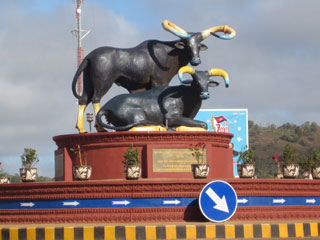
Mondulkiri is an eastern province of Cambodia, which is the most sparsely populated province in the whole country although being the largest province in Cambodia. The province is chock full of natural beauty, with thickly forested mountains, powerful waterfalls and the lush green rolling hills of the western side.

Despite the growing deforestation, especially due to the valuable minerals remaining in the deep red, fertile ground, Mondulkiri has still one of the biggest successional woodlands of Cambodia. Except being in Sen Monorom, you'll find deep pure jungle, with a huge variety of flora and fauna. You may also find gigantic and beautiful waterfalls, where you can take an empowering shower, such as the impressive Bou Sraa.

Sen Monorom is the provincial capital and doesn't show up as a typical Cambodian town, while it is the only town the province has to speak of. With approx. 7500 inhabitants, 20 guesthouses, 12 restaurants, 3 bars and no post office it is often compared to American Wild West frontier towns. Concerning the quietness and beauty of Sen Monorom people from other parts of the country move here and therefore the land price doubled from 2006 to 2007.

The town of Sen Monorom is the best base camp for travellers who want to explore the surrounding areas. A quiet but beautiful town nestled into the hills; it has a lot of potential to develop into a centre for non-intrusive eco-tourism. At present, it's very undeveloped, which gives you a feeling of going somewhere off the beaten tourist trail. Add to that the communities of hill tribe people, who are not affected by mass-tourism, as they are in neighbouring Thailand, and you have an area that is very attractive to the adventure traveller.

Also interesting is the variety of languages being used: Khmer, hill tribe languages, Vietnamese and Lao. 80 percent of the population in Mondulkiri is made up of ten tribal minorities, with the majority of them being the Chunchiet from the tribe of the Phnong. The remaining 20 percent are Khmer, Chinese and Muslim Cham. Most of the population lives off the land, planting rice, fruit trees and a variety of vegetables. Others grow, coffee, strawberries, rubber and cashew nuts.

More and more houses are built in the typical Khmer style. Visiting the hill tribes you still can find the traditional Phnong houses. In the houses you can find traditional gongs and big jars, whereby the last ones are said to be more than a thousand years old. There are various sorts of gongs used for different occasions. Jars and gongs are among the most valuable possessions in an indigenous community, whether in traditional, spiritual or material terms. During the Khmer Rouge Regime those objects were buried in hidden places in the jungle and in many cases they still wait in the ground.
Introduction - Preah Vihear, Cambodia


Introduction

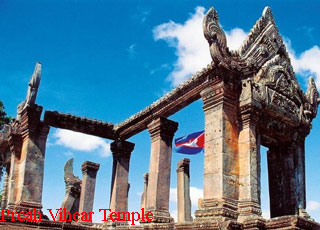
Preah Vihear is quite a big northern province of Cambodia. Its capital is called Phnom Tbeng Meanchey. The province itself is named after the temple of Prasat Preah Vihear, what is definitely the hotspot of this province. Much of the province is extremely remote and strongly forested. Unfortunately do large logging companies reduce the natural landscape by carving huge tracts of pristine tropical hardwoods out of the locations. It is also one of the least populated provinces in the Kingdom of Cambodia. This tranquil site is popular for the Preah Vihear temple, standing in the vicinity of the borderline between Thailand and Cambodia.

The province has one of the worst infrastructures in the country there are even no proper Major Roads in existence. Going around this province is not that easy if you're used to proper roads and usual transportation possibilities, as there are only a few pick-ups or some money-hunting moto drivers to take you where you would like to go.

Whatsoever the province has a lot to offer for those, who are interested in ancient temple structures and remote villages without touristy influence. Here in Preah Vihear you may find three of the most impressive legacies from the Angkorian era: the mountain temple of Prasat Preah Vihear, the 10th-century capital of Koh Ker and the mighty Preak Khan.

Koh Ker is nowadays easily accessible from Siem Reap via Beng Mealea, but the other two still remain difficult to visit, requiring long and tough overland journeys and a distinct possibility to spend a night in the jungle. During the wet season these places are more or less unreachable. But there are governmental plans to develop the region for a smooth but constant tourism, building roads and improving infrastructure.

The provincial capital Tbeng Meanchey is due to the state of the infrastructure and it's geographical location not visited by a lot of foreigners. Most of them don't make it here worrying about the street conditions and the backcountry feeling of no fast supply in need. The city is sprawling and dusty and consists of little more than two small major dirt roads form South to North. There is nothing interesting in town or to do, so it has necessarily become more a stopover on the way to Koh Ker and Preah Khan.
Independence Monument - Phnom Penh - What to See
An Angkorian style tower, the inimitable place in the whole city, located in the heart of the capital. It was built in 1958 to Sybilles Cambodian Independence Day after winning back their independence from the French protectorate on the 9th of November 1953. The monument attracts many tourists for its peculiar looking but unique style distinguishes it from all the buildings in the city. It is also used as a memorial place dedicated to the Cambodian's patriot who died for the country. The Independence Monument (Vimean Ekareach) was inaugurated on November 9, 1962 to celebrate the independence from the French in 1953, but now also serving as a cenotaph to Cambodia?s war dead. The 20-meter high monument was designed by Cambodian architect, Vann Molyvann, and is shaped in the form of a lotus, which also can be seen at Angkor and other Khmer historical sites. You are not allowed to enter the monument. At night it is lit with blue, red and white light (the colours of the national flag) and it should be an impressive sight - but I didn?t see it. There is a big open park at the Independence Monument and it seems to be a popular place among the locals. Smacked right at the corner of Norodom and Sihanouk Blvd, this piece of landmark is hard to miss. I took a nice picture of this piece but be careful because it is located in the middle of a roundabout.The monument was built in 1962 to celebrate Cambodia's independence from the foreign rule. It also serves as a monument to Cambodias war dead. It is the site for celebrations and services.When walking around in the city of Phnom Penh, have a look on the Independence Monument,10 minutes walking behind the Royal Palace. It is surrounded by very large parcs and fountains and the monument itself is not the most impressive in the city. The Independence Monument in Phnom Penh, capital of Cambodia, was built in 1958 following the country's independence from France. It stands on the intersection of Norodom and Sihanouk Boulevards in the centre of the city. It is in the form of a lotus-shaped stupa, of the style seen at the great Khmer temple at Angkor Wat and other Khmer historical sites.The Independence Monument was inaugurated in 1958 to celebrate Cambodia's independence from foreign rule, now it also serves as a monument to Cambodia's war dead. At night the monument is illuminated by red, blue and white floodlights, the colors of the Cambodian flag. It is the site of celebrations and services on holidays such as Independence Day and Constitution Day.
Introduction
Phnom Penh is the vibrant bustling capital of Cambodia. Situated at the confluence of three rivers, the mighty Mekong, the Bassac and the great Tonle Sap, what was once considered the 'Gem' of Indochina. The capital city still maintains considerable charm with plenty to see. It exudes a sort of provincial charm and tranquillity with French colonial mansions and tree-lined boulevards amidst monumental Angkorian architecture. Phnom Penh is a veritable oasis compared to the modernity of other Asian capitals. A mixture of Asian exotica, the famous Cambodian hospitality awaits the visitors to the capital of the Kingdom of Cambodia. Here in the capital, are many interesting touristy sites. Beside the Royal Palace, the Silver Pagoda, the National Museum, the Toul Sleng Genocide Museum, the Choeng Ek Killing Fields and Wat Phnom, there are several market places selling carvings, paintings, silk, silver, gems and even antiques. Indeed, an ideal destination for a leisurely day tour. The whole area including the outskirts of Phnom Penh is about 376 square kilometres big. There are currently 2,009,264 people living in Phnom Penh. The city takes its name from the re-known Wat Phnom Daun Penh (nowadays: Wat Phnom or Hill Temple), which was built in 1373 to house five statues of Buddha on a man made hill 27 meters high. These five statues were floating down the Mekong in a Koki tree and an old wealthy widow named Daun Penh (Grandma Penh) saved them and set them up on this very hill for worshiping. Phnom Penh was also previously known as Krong Chaktomuk (Chaturmukha) meaning "City of Four Faces". This name refers to the confluence where the Mekong, Bassac, and Tonle Sap rivers cross to form an "X" where the capital is situated. Phnom Penh is also the gateway to an exotic land - the world heritage site, the largest religious complex in the world, the temples of Angkor in the west, the beaches of the southern coast and the ethnic minorities of the North-eastern provinces. There are also a wide variety of services including five star HOTELS AND budget guest houses, fine international dining, sidewalk noodle shops, neighbourhood pubs international discos and more. Phnom Penh, like other Asian-City tourist destinations, is in the midst of rapid change. Over the past few years the number of restaurants and hotels have grown considerably and in the last year there had been a huge increase in the number of visitors. Come and see a real original as it won't be the same in a few years.
Introduction - Siem Reap, Cambodia arrow Introduction arrow Geography arrow Climate arrow Population arrow Economy arrow How to Get There arrow What to See arrow Where to Eat arrow Where to Stay arrow Shopping arrow City Map Introduction
Siem Reap province is located in northwest Cambodia. It is the major tourist hub in Cambodia, as it is the closest city to the world famous temples of Angkor (the Angkor temple complex is north of the city). The provincial capital is also called Siem Reap and is located in the South of the province on the shores of the Tonle Sap Lake, the greatest sweet water reserve in whole Southeast Asia. The name of the city literally means Siamese defeated, referring to the victory of the Khmer Empire over the army of the Thai kingdom in the 17th century. At the turn of the millennium Siem Reap was a Cambodian provincial town with few facilities, minor surfaced roads and little in the way of nightlife. Tourism industry catered largely to hardy backpackers willing to brave the tortuous road from the Thai border on the tailgate of a local pick-up truck. There were a couple of large HOTELS AND a handful of budget guesthouses. Tuk-tuks and taxis were non-existent and the trusty motodup was the chosen means of touring the temples of Angkor. The proximity of the Angkorian ruins turned Siem Reap into a boomtown in less than half a decade. Huge, expensive hotels have sprung up everywhere and budget hotels have mushroomed. Property values have soared to European levels and tourism has become a vast, lucrative industry. The Siem Reap of today is barely recognizable from the Siem Reap of the year 2000. Though some of the town's previous ramshackle charm may have been lost the developments of the last few years have brought livelihoods, if not significant wealth, to a good number of its citizens. This has been at a cost to the underprivileged people living within and beyond the town's limits that now pay inflated prices at the central markets and continue to survive on poorly paid subsistence farming and fishing. If Cambodia is a country of contrasts Siem Reap is the embodiment of those contrasts. Despite the massive shift in its economic fortunes, Siem Reap remains a safe, friendly and pleasant town. There is an endless choice of places to stay or dine and a host of possible activities awaiting the visitor.

Book hotel in Siem Reap Now : Click Here
Koh Ton Say Resort - Kep
Koh Ton Say Resort - What to See Koh Ton Say Resort is the natural resort locating at the Southeast of Kep town in 4.5-kilometer distance from the town, and has two beaches suitable for swimming because they have white sand and shallow water. At the bottom of the sea, there are varied fish, plant and coral, which enable the research on ecology. The name ?Koh Ton Say? comes from the word ?Rum Say? meaning ?Spread out?. Because when the King, Sa Kor Reach is hopeless for struggle due to his troop and parties break off, he leads the remaining troop acrossing the sea to an island in front of Kep town, then his troop spread out there. So that we call the island ?Koh Rum Say?, after that we call ?Koh Ton Say? until now. Koh Ton Say has two-square kilometer landarea. Before, prisoners were sent here for correcting and defending the island. The tourist infrastructures at the island were constructed during the Sang Kum Reas Ni Yum time such as path of horse cart around the island, wooden motel and restaurant, clean-water system and other administrative buildings etc. But, because of the past more than two decades of war and natural disaster, these infrastructures have almost completely been damaged. Nowadays, the island settled by seven families, who earn their living by small fishing and maintaining coconut plantation.